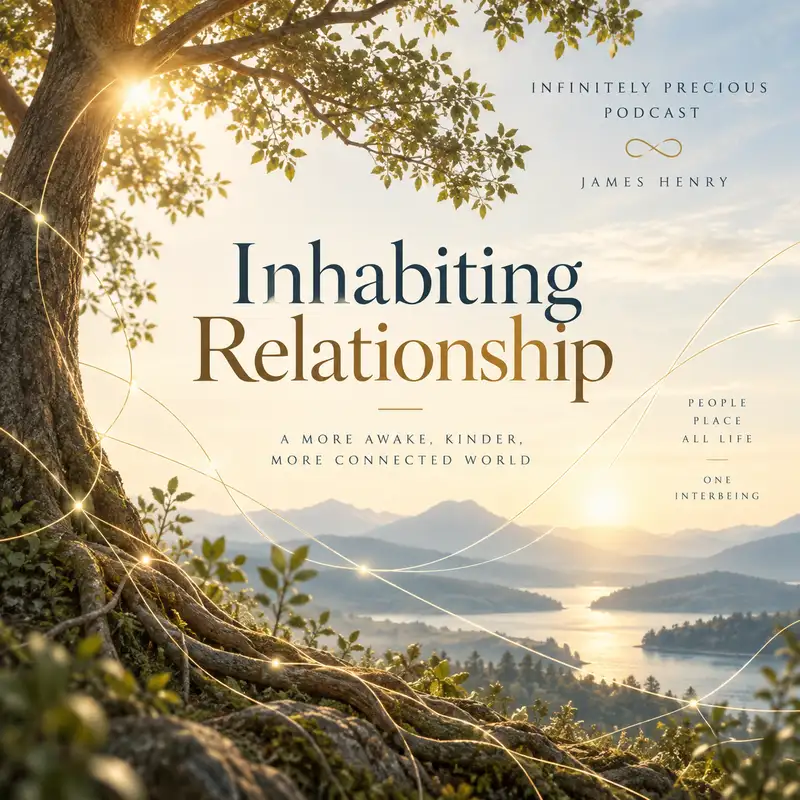
Inhabiting Relationship
Welcome to the Infinitely Precious podcast produced by Infinitely Precious LLC. Your host is James Henry. Remember, you are infinitely precious and unconditionally loved for the gift you already are.
James:Well, hello, beloved. It's me, James, and I am delighted to be with you today to be your companion here in the Infinitely Precious podcast. So thank you so much for joining. We've been on this journey together for more than 100 episodes. So if you've been here from the beginning or if this is your first time with us, thanks for coming.
James:And if you find this helpful, I invite you, encourage you, if you would, to share this. I hope it'll be a positive voice in the world, encouraging a sense of connection and perhaps deepening that sense of connection in the world in which we live. We are in the midst of a series of podcasts, all of which the title begins with inhabiting. So we began by talking about how we inhabit the preciousness that is a given within us. We moved on from there.
James:Ultimately talked about inhabiting pain and struggle, which is hard to stay in. We want to run away. Inhabiting grief. And naturally, even as I was speaking last week's Inhabiting Grief piece, I felt inhabiting relationship arising. Inhabiting is learning to be from my perspective anyway, that's how I'm using the language, is learning to be where we are, where I am right now.
James:Not trying to be somewhere else. Ripening, the ripening series which came before this is about the movement that's constantly taking place in our life. As we become more ripe or less ripe, we're moving towards fullness or away from fullness sometimes. And so we talked about nine dimensions of ripening. I'm not sure exactly how many dimensions we'll end up talking about with inhabiting.
James:So if today's topic is inhabiting relationship, what is that all about? Well, first of all, I want to say for all of us, if you're listening to this, inhabiting relationship is something that we have done since before we were born into this world. In the womb, we were part of relationship. Emerging from the womb, we became a part of a relationship. That relationship encompasses everything from being a part of an infinite universe to being a part of this solar system in particular embedded in this planet, this earth.
James:When we were born, we were related to people by blood. We are related to all the ancestors. We are inheriting so much from them genetically and otherwise. We we're in relationship with the air that we breathe after birth or the struggle we have to breathe the air with these bodies in which we find all the sensory organs through which we relate to the world. We are born and we're already in relationships.
James:So that's the first starting place. To learn to inhabit the relationships we already have, to recognize I am in relationship to the planet. I am in relationship to the air I'm breathing right now. I am in relationship to the vibrations that are coming from my throat because of the air that rises up and is vibrating through my larynx and allowing me to speak by shaping these words. I'm in relationship to these words that flow from me.
James:Even as you listen to this podcast, you are in relationship to me if in no other way that spirit connects us in some way across the distance. You are related to the ideas that I share. You can push back on them. You can welcome them in. They can be a springboard for your own thinking and sharing.
James:And by the way, I always welcome sharing. If you want to send me something at jamesinfinitelyprecious dot org, I would welcome your thoughts. So we're born into relationship. Now, one of the things that sometimes happens in our lives though is we begin to treat relationships as transactions. What can I get out of this connection?
James:It's not enough simply to breathe the air. I want something more from the air. I don't know exactly what that is, but I want it to I want more. In relationships with people or with work that we do, we begin to imagine that relationship for what it can give us. It becomes transactional.
James:I will do this if you will do that. I will give you if you will give me. I will love you if you love me. And I want to say to you, at least from my experience, that relationships are more than transactions. Yes, transactions give rise to some relationships.
James:You go to the store and you buy something and you in one form or another, make payment to a person who might be behind the counter and you are in a form of relationship with them. It may not seem like a very deep relationship to you, but it is a relationship nonetheless. You walk on the earth and you are in relationship to that earth upon which you walk. I've told you before in as a part of this that oftentimes I sit in my spiritual chair right over here. It's just a chair.
James:I have a relationship with it because I've been sitting into in in that particular chair for probably about fifteen years now. The same chair in different places hasn't always been where it is right now. And I look out the window. From this particular chair, when I'm looking out the window, I can see a beautiful pine tree. It's beautiful to me.
James:I'm in relationship to it. If in no other way I gaze upon it and watch it dance in the wind and do other things, I am in relationship to that pine tree. We are in relationships. Born into them, live in them, and ultimately die in them. We are in that web of relationship.
James:What would it look like if instead of treating relationships, whether they're love relationships, teaching relationships, fellow students, peers, coworkers? What if we treated those like they were worth inhabiting? They weren't just a transaction for me to get something out of. What would it be to inhabit those relationships as gifts to us, recognizing that they bring something into our lives that we may that we would not otherwise have. Inhabiting the relationship is not trying to change the way that it is.
James:It's simply learning to be in it the way that it is. You may wish for it that it will ripen into a healthier thing and listen to the ripening series. We'll talk about that. But what does it look like to be in a relationship, particularly to inhabit a relationship that in some way is challenging to you, irritating to you, that pushes your buttons? How do you remain in that?
James:How do you treat it as something other than transactional? You're going to irritate me, so I'm going to either ignore or irritate you back or do some other third thing that I can't imagine in this moment. What does it look like to inhabit relationships, to stay in them, to recognize them, to live in that space even when it's not a pleasant space. It's like a couple of weeks ago when we talked about inhabiting pain last week when we talked about inhabiting grief. When we stay in those spaces, sometimes we learn something about the nature of in this case, maybe about the nature of relationship itself.
James:What is it to be in relationship with the air I'm breathing right now, the carbon dioxide that I'm releasing as I breathe out, what is it to be in relationship with that? What is it to be in relationship with you across the distance here as you listen to this podcast wherever you are? What does it mean to be in relationship with someone who may be, 10 or 100 or 1,000 miles away from me? What does it mean? Because we share a relationship.
James:It may be not in our minds a direct relationship. You may have begun to think, I used to think completely, that relationships were people I actually saw, touched, held, spoke with. But what does it mean to be in relationship with all of humanity? The 8,000,000,000 of us that inhabit this planet. How do we inhabit that relationship?
James:How do we honor? One thing about inhabiting thing, it invites us to honor as we come to appreciate the relationship I'm already in. All of them, this whole web that comes in on me that until I think about it, I don't pay any attention to. What does it mean to honor those relationships, to honor the voices of all the other relationships I'm in? How do I honor the planet?
James:How do I honor the sunshine that comes down on me every day? The rain that according to my Apple Watch should be falling at any moment, warned me just before the podcast began. What does it mean to live, to inhabit, to let the space I'm in be a reflection of all the relationships of which I'm a part and have always been a part? Those relationships may be evolving. They may be changing, but I'm always in them.
James:I'm always a part of them. Even the people who I've recently been reflecting on some of the relationships that didn't work out in my life that are broken and that I played a major role in breaking. What that relationship still exists. It's broken. It will based on my experience of those two broken relationships, they are irreconcilable.
James:There is I dream sometimes about those relationships coming back together in a way that could be positive through healing and wholeness. But whether or not I'm in a speaking relationship with those broken relationships, even a broken relationship is a relationship. So the invitation is to appreciate and abide in and recognize the relationships, not just the person to person relationships of the people who sit in front of us, who work with us, who play with us, who are related to us. But what does it look like to inhabit relationships with all of the other pieces, with the technology in our life? Sometimes we let the technology of our life become the factor that our relationship is not a healthy one.
James:We spend all of our time looking at that. What does it look like to inhabit a relationship in such a way that you can recognize when it's healthy, when it's not? We are in the web. You and I are in a web of relationships. I'm thankful for you being a part of this podcast and helping me sustain that podcast over these last several years.
James:I wish you the best. And I want to invite you, as a part of your inhabiting to pay attention, to recognize, maybe to sit back in a quiet moment and just think of the relationships you have. Maybe as you're breathing, think about your relationship to the atmosphere. Perhaps when you're out of doors or sitting by a window as I do, when you notice a tree or the grass outside, all of that photosynthesis that happens around us, the relationship I have as I breathe in the oxygen that's produced by my plant sisters and brothers, among other things, and the carbon dioxide I breathe out that they use as a part of their being here. That relationship, what would it look like to sit and ponder your connection?
James:All of the connections that you don't even pay attention to. The connections to being a part of a particular nation or country or community you live in, if you belong to a spiritual or religious institution or connection or community, what does that relationship do to, with, for you as a part of it? Have you even thought about how you are connected to so many different things? How spirit connects you to everything? Since before you were born, you were a part of it all.
James:You can even ponder how part of what makes you up is stardust because the heavier elements that are part of our bodies were formed, not in the initial big bang, but as stars collapsed, very large stars as well as small ones, and helped us come into being, helped life be supported here on this planet. It's all a miracle and you're in relationship to all of it. So take the time, ponder that, and remember in the midst of all of that, you are infinitely precious and unconditionally loved for the gift you already are in this ever evolving web of relationships of which you're a part. Thanks for joining me today, and I wish you all the best.