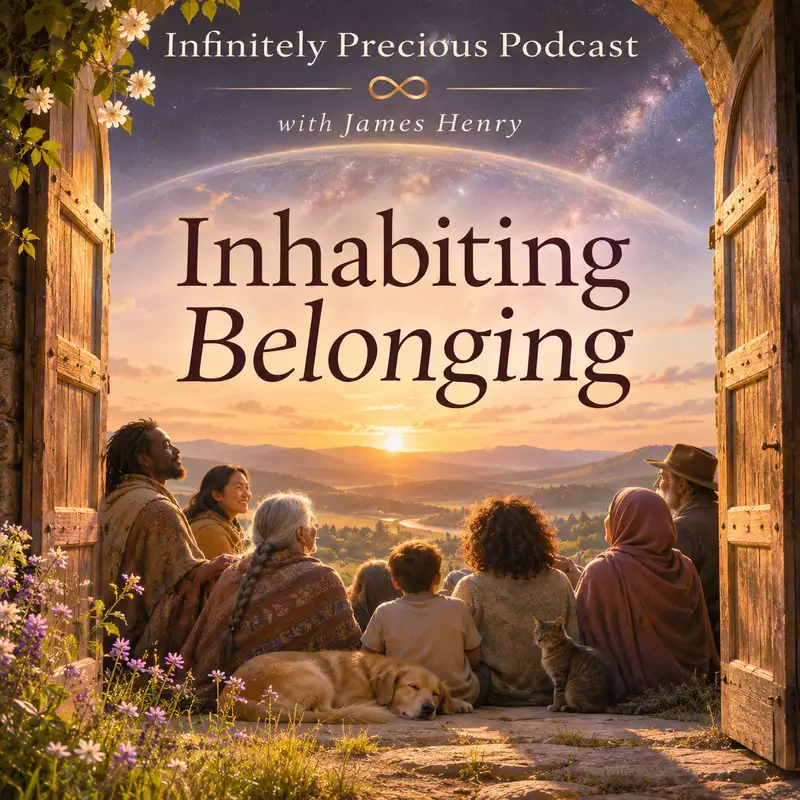
Inhabiting Belonging
Welcome to the Infinitely Precious podcast produced by Infinitely Precious LLC. Your host is James Henry. Remember, you are infinitely precious and unconditionally loved for the gift you already are.
James:Hello, beloved. It's me, James, and I am so delighted to have you with me for another week, episode of the Infinitely Precious podcast. It's good to have you here and it's good to be here with you as a companion. We share that companionship whether we can see each other or not. And speaking of that, a question has been arising for me as a part of the Inhabiting series.
James:And so the next topics that seemed most appropriate to me was to talk about how we might inhabit belonging. Have you ever walked into a room where perhaps you didn't know anyone and from the very beginning you wondered if you might find belonging in that space. Perhaps it was a first time visit to a club or an organization or a church. Do I, can I, will I belong here? Or perhaps you've struggled to find that you find yourself walking into a room as I do every year at annual conference for the United Methodist Church in Virginia.
James:When I go into a clergy session of the United Methodist Church, I'm looking around, yes, I belong in that room because I'm a clergy person, but I'm looking around for the people with whom I sense that belonging most fully, the people I already know perhaps or people who feel most welcoming and warm in those spaces. Belonging is very important to us. And it's almost a survival instinct, it seems like to me, from the time we're very small. We need to have a place where we feel like we belong and where we feel safe and secure, perhaps protected when we're too small to do that for ourselves. It's kind of the thing we hope for.
James:So what I want to talk about today and when I think about it, I've begun to think about belonging and inhabiting belonging as the recognition that before anything else we already belong. That it's part of who we are, it's part of how we're made, it's part of where we are in the universe. Last week we talked about inhabiting silence and it was out of that silence that a spaciousness for everything to arise emerged. At least that's from my perspective. When I read Genesis one, not just about a seven day account of how things came into being, but as beginning in an implied silence, I've inferred it there.
James:Beginning in an implied silence, everything that arises in each of the days, light and darkness, night and day, the stars, the moon, the animals, all those pieces all belonged from the very beginning because they arose in that spaciousness. And before you were, you belonged. And now that you are, you belong. Now, even as I say that, you may hear that with a certain amount of pain attached to that word belonging. Perhaps you've been part of a group that in one way or another rejected you.
James:Perhaps it was the church. Perhaps you're a member of the LGBTQIA plus community and the church said, you don't count. Or perhaps you were a member of a family that had very rigid rules about things that you violated and you were disowned, shunned by that very family because you didn't fit the rules. Maybe you were a part of an organization that said because of something you did, you no longer had a place. You didn't belong.
James:There is real pain in that. When an organization, when a group of people, when your friends say you're not a friend anymore and suddenly you're cast out on your own, there's a certain fear, there's a certain pain to that because we fear to be outside of groups. Groups make us feel safe, I think. They make us feel like we might survive. I think it may come from our deep evolutionary involvement that as we rose, we discovered that in tribes we might have protection, we might have safety, we might have cooperation and participation, and that helped us to live on.
James:And so when someone rejects us at the deepest level, we feel the pain of it. We feel the fear of what it would mean to not belong to something that we were at least hoping would help make us feel like we belong. My ponderings have led me to believe that you can never not belong. It's from that statement I made just a little bit earlier. From the spaciousness of all that came into being and is coming into being and will come into being, you arose.
James:And so you were always a part of all that is, the interconnectedness of this vast infinite universe. And because of that, you and I are part of things. We are related from before the whole process began. We are connected. We are related.
James:We belong. In some ways, this echoes back to my first episode, the episode about inhabiting our infinite preciousness. But I think this may even go deeper than that in some ways because belonging is recognizing our part in the community. And not only our part, but that everyone and everything, all that we come in contact with is already belongs. It already belongs.
James:What would happen if you were in an organization and somebody walked in and looked looking lost but you knew upon looking at them that they already belonged because the core principle by which you live was inhabiting this belonging, recognizing no matter who they were, they had a place. They were here. And that that belonging then might make you see them and treat them differently. I hear churches speak about a variety of I work in a church. And while I'd like to believe my perspective is bigger than just that institution because in so many ways it's finite and limited.
James:You know, work in churches and you hear people say things like, I can't tell if that person belongs. They look different. They might smell different because particularly if they're unhomed or have other kinds of challenges, they don't quite fit the norm for the community. Does that mean they don't belong here? Part of what the church supposedly says is all are welcome and all belong.
James:And what's interesting is there's a difference between belonging and being welcomed. If belonging is existential, being welcomed is something that communities have the opportunity to do to us. I'm saying that regardless of whether they do or not, we all belong. Before everything else underneath, underpinning everything else, we belong to this vast interconnected universe. The divine is present in every one of us and all things everywhere.
James:We are not the divine, but we are not other than the divine either. The divine resides in us. But we aren't always good at welcoming those things that are different than us whether they belong or not. And part of what I see as inhabiting belonging is beginning to recognize that first of all I don't have to prove that I belong here. There's no proof.
James:Even if I'm kicked out of a church, a family, a group, I will always, always have belonging underneath of it. It doesn't mean that if I get kicked out of a church, a family, a group, that it doesn't hurt, that it doesn't make me question how it's possible or whether I belong in the world. When welcome is not when the welcome mat is not out, then it makes us feel as though perhaps we don't really belong. I remember early in my ministry, part of my visitation was with a gentleman who was old enough to remember a time when doors didn't have handles. That what they had was a latch on the inside and when you needed to get in, you put a rope that was attached to the latch through a hole in the door and a person could pull on it, it lifted the latch and opened the door.
James:And the thing he always said to me when I came to visit him and it just came up for me is the latch string is always on the outside for you, which means you are always welcome. You always belong. That kind of phrase is a wonderful one. Doesn't mean that we always feel that way, particularly when there is a group that might be more clickish or may more have very defined boundaries around which they don't seem to want to include you. But you will always belong in this interconnectedness.
James:So what do we do about this? Why does it make any difference at all? And the difference is if I begin to inhabit this belongingness, I'm not waiting for somebody else to make me feel like there's a place for me. I know there's a place for me and I'm comfortable in that. Your acceptance of me, your decision to let me in or not, it doesn't reflect reality.
James:It reflects the other person's reality. It reflects your decision to include me or not, but I always belong. I always will. I may feel discomfort. I may feel deep pain, rejection, all of those kinds of pieces when an organization chooses or a group or an individual chooses to push me out.
James:But if I can learn to live in the fact that I belong and not only that I belong but that everything belongs. All, everything belongs. We are all part of one another. We all participate in the great being, the great movement of being. And as such, we get to be inside of it.
James:We are already belonging. I wish that was just a simple way to make you feel better if you're feeling like you're on the outside. I wish it were as simple as saying, oh, you definitely belong. And you could just not feel bad when you're rejected or cast out by various groups who say something about you makes you less than. But I'm here to say to you, that's a lie.
James:Anybody telling you that you're less than is simply a lie. You might not fit their mold, but you have belonged since before you were. You belong right now and you will always belong. And to learn to inhabit that belonging is to get comfortable in knowing that before all else you did belong. You do belong.
James:You will belong. So And will everyone else. Might change the way you treat them, might change the way you treat yourself. I already belong. I don't have to beat myself up because I don't quite fit everyone else's mold.
James:And if I show who I really am in this group and they reject me, simply means they don't see what is already true about me, which is that I already belong. That's part of the implication in my phrase, the phrase that I always end with and the phrase that I'm about to end with now. No matter what anybody else says about you, no matter how many people have told you you don't belong and there's something weird or strange or nerdish or whatever word they use about you. No matter any of those things, the deepest truth about you is that you already belong because you are infinitely precious, you are unconditionally loved, and you are already a gift for who you are right now. I hope you'll keep that in mind.
James:I hope that helps. It doesn't make the pain go away and I'm aware of that. There have been times in my life of deep rejection. There have also been times of deep welcoming. I hope for you, you find those welcoming moments.
James:But even if you don't, that you can remember you belong to something bigger than any organization, any group, any friend group or friendship that you belong. Let's all try to inhabit that a little bit better. Those are my thoughts for today. Thanks for joining me on the Infinitely Precious podcast. I wish you all the very best my friends.