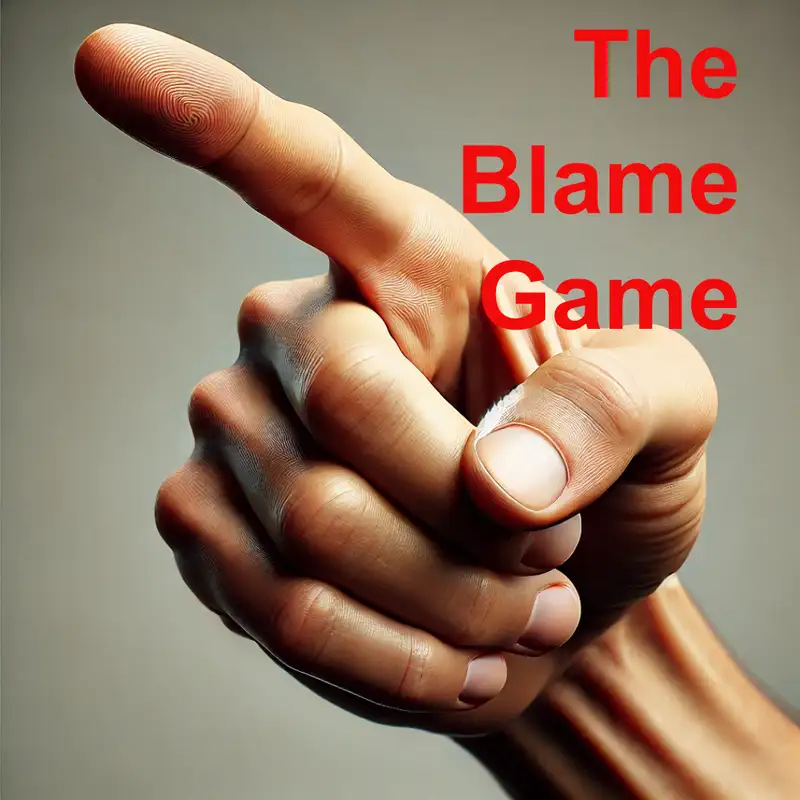
The Blame Game
Welcome to the Infinitely Precious Podcast produced by Infinitely Precious LLC. Your host is James Henry. Remember, you are infinitely precious and unconditionally loved for the gift you already are.
James:Hello, beloved. Coming to you today to talk about something that's on my mind recently. It's on and off, off my mind most of my life and it's what I like to call playing the blame game when we are quick to point out others' mistakes, oftentimes so that we can feel better about our own mistakes. I find that this is especially prevalent among political leaders, although quite frankly it seems to be pretty prevalent among a lot of leaders. There's always someone to blame.
James:I want to say to you something very important about blame. It doesn't hurt to understand where responsibility lies with the challenges we face in life. When we look at the challenges that come our way, we can see what part others play in bringing those challenges our way, but I also think if we're really honest and self aware, we recognize that we play a part in that. Sometimes we are the primary cause, the primary mover in what has transpired that we want to pass blame on to someone else. It's helpful to recognize that part of the reason why blame is such a good distraction in our society today is because when we know who to blame, we don't have to necessarily do anything to fix it ourselves.
James:It's someone else's fault. It's someone else's responsibility, not ours. And it sort of relieves us of the sense that we have to do something about it. If it weren't for those people or that person, I wouldn't be in this situation right now. And look at me, I'm the only one who's willing to try to solve whatever this problem is.
James:The blame game redirects attention somewhere else, but in so doing, it distracts us from what we can do about whatever we are facing right now. Playing the blame game is great if we don't want anyone to blame us, So the quicker we can get out there in front of it and point our finger to someone else, the quicker we can absolve ourselves of any responsibility, even when we're responsible. At the very least by our common humanity, the part we played in whatever it is. So when I think about blaming, I have to invite myself to take a step back. Once again, this whole taking a step back, taking a pause, it's not our natural response, especially when challenges come our way.
James:Our natural response is to point fingers, to blame, to react in all sorts of ways, but perhaps, perhaps, if we can take a pausing moment and look at whatever the problem is, instead of trying to figure out who we want to blame for it so we don't have to take any responsibility, maybe we can look at the place that we can stand that might actually solve the problem. Blaming redirects the issue and doesn't set up any responsibility to solve it, unless I want to be the savior, and of course it's their fault or that person's fault, but look, I'm the solver, I'm the savior, I'm the superhero that's gonna arrive on the scene to fix it. The blame game allows us to differentiate ourselves from others. It allows us to say, I'm the blameless one, they're the blame filled one, and scapegoating has never gotten humanity very far. We have used it over and over again rather than take responsibility ourselves and seek to rectify what we can, what part we played in where we are right now.
James:So step back, pause, why do I want to blame this person? Whoever that person is, why do I want to blame this group of people? What is really going on inside of me about this situation? Is there really any blame to go is there blame to go around? Is there a way I can take some responsibility for some part of this, and the part that is mine, I can do something about that?
James:Is there someone that's being blamed that's used as a scapegoat who is now gonna bear the brunt of any forces to try to fix it, even if they may or may not be the source of whatever the issue is. Am I called in this moment to stand for the person who is being blamed or the group that's being blamed? How quickly can I be part of the solution and help stand up for those who might be being blamed? Now, the other side of that might be when you're the person who is being blamed. What can you do when you're being blamed for something?
James:Same thing, step back, take a pause. What part did I play? Is some of the responsibility mine to take? And if it is, I can own that, I can name that, I can state that out loud and be okay that I played a part in making that happen. I can claim that, but I also if I did not play certainly a major part, if I was just a convenient target, I can also catch my breath in that moment and just let it go.
James:Someone is looking for a convenient target, and I'm that target right now. Is this part of the history of the person who likes to blame other people? Always blaming someone else rather than taking any responsibility themselves. If that is their pattern, then you don't even necessarily have to take them seriously when they blame you. At least for yourself.
James:Recognize this is just the way this person operates. Rather than face responsibility for things they've done, for mistakes they've made, they would much rather put it off on someone. And that's on them. It's not on me. But there may still be something I can do besides just screaming out loud because you've blamed me yet again for something I didn't do.
James:Instead, I can take a step back, let it go, think about my part, do what I can to make things better, Because after all, isn't that part of being human is the desire to make things better, to work to make it better, not just for me but for all of our common humanity. I think that the one that I follow with my life, Jesus, constantly pointed out ways that we could make the world better, not for the few, but for everyone. So the next time I'm tempted to blame someone and I get tempted all the time I'm sure that someone is the cause of all the problems and it's almost never me Maybe instead I can take a pause, and the next time I'm ready to blame, say to myself, All right, what part did I play in this? How can I change the way I perceive this by recognizing my part in it? And can I do anything to rectify the situation from my end, taking responsibility for the part that's mine?
James:I've talked about this before, about figuring out what's yours to do and doing it. This is once again an opportunity to do that, but in a slightly different situation. When your propensity is to blame someone else for the challenges or problems you face or that we all face, when it is your propensity or when you are the receiver of blame, you get to take a moment to step back and say, how much of it really is mine? If it's none, is there still something I can do to help make it right? Is there someone who can't quite defend themselves who is the brunt of this?
James:How can I stand up with those folks or with that person? Can I be that courageous? Do I have the courage to do that? And if you play no part in it, just let it go. If you play some part in it, what can you do to fix it?
James:That's really about all we can do is in any given moment, wherever we are, whenever we are, is do the best that we can with what we have. And there is no need for blame. It may be a temporary way to feel better about ourselves when we blame someone else and redirect their attention, but it's really kind of a shell game. I play a part, let me see what I can do about it. You say I played a part, I may not have played a part, but maybe I can be part of the solution.
James:That is an opportunity we all have. Whatever you do in the blaming game, whether you are a blamer or the receiver of blame, or that you seek to rectify situations of blame, and hopefully, you've probably, whether it's hopefully or not, you've probably played a part, all those parts. The key is to be self aware enough to realize where you are in the blame game and what you can do to change things, what you can do to make a difference. No matter where you find yourself, remember always, though, you are infinitely precious and unconditionally loved for the gift you already are. Until the next time.