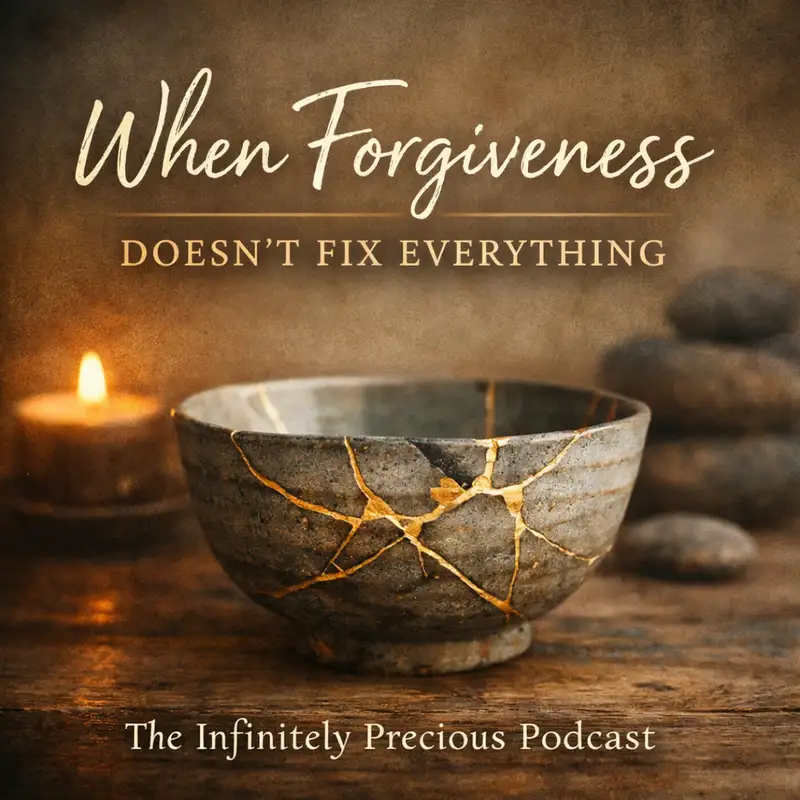
When Forgiveness Doesn't Fix Everything
Welcome to the infinitely precious podcast produced by infinitely precious LLC. Your host is James Henry. Remember, you are infinitely precious and unconditionally loved for the gift you already are.
James:Before this podcast begins, want to say that I listened to the podcast, and as I listened to it before I put it out for you, I want to say this reflection is a little more layered than some of our time together. If you find yourself drifting, don't worry about it, that's okay. You don't need to understand every word. Just listen for what resonates, and let the rest go. And thanks for listening.
James:Hello, beloved. It's me, James, and it's time for us to be companions on the journey again for a few moments as I share some thoughts. We're always companions, I suppose, but there are intentional moments in which we share together on this journey. And I'm thankful for those. Thanks for being a listener to the Infinitely Precious podcast.
James:And when you find it meaningful for sharing it with others along that same companioning journey that we're all on together. Today, I wanted to take a moment to talk about forgiveness and when it feels like forgiveness doesn't fix anything because the nature of forgiveness is such that we constantly hear it's important for us to do it, to let go of the things that we hold regarding other people, the nature of the world in which we live and everything else as having been done wrong to us. And so in the midst of that having received a wrong, been wronged, part of our work is to let go of the wrong. That's what forgiveness really kind of boils down to. I wanted to take a moment, and I really don't like these journeys to be based around a whole lot of theory or to be teaching moments because I don't know that I'm a teacher when it comes to these things.
James:But I wanted to share, first of all, some thoughts about how I understand the nature of things. And then the understanding perhaps of how forgiveness fits into that larger picture. I understand that all in the universe are connected relationally. That we live, if you will, in a relational field that is empowered by spirit, that the divine is active in that field, and that we are in some ways manifestations of the infinite in the way that we live our lives. Now, each of us is a finite manifestation of that infinite.
James:And it already feels a little theoretical, doesn't it, for me to be talking in those kinds of words. But it's the best way I can describe what we're in. And as a relational field, there are moments when we become misaligned with the divine intent, the divine movement, the heart's desire, if you will, of the divine. And that misalignment is sometimes with the divinity itself, with one another, with the world in which we live, the nature and fabric of it. And those kinds of rifts enter into kind of an incoherence rather than a resonance or a coherence to the relationships.
James:As such, when those rifts happen, something is broken. I think I can't think of a better word for it. Something is broken in that misalignment. And no matter how hard we work at repairing that which is broken, there will always be the scars left behind. If you're looking for an example of that from sacred texts, when Jesus shows up after the resurrection, after the new life, he shows the disciples the scars that he still carries.
James:His identity is not shaped so much. He is not those scars, but certainly who he is has been shaped by those scars. And he still bears those scars. When I think of forgiveness then, I think a little bit about the Japanese art of kintsugi, which quite frankly I may have completely mispronounced, but it's the Japanese art of repairing broken pottery by reconnecting the shards using gold. And traditionally, they use real gold, melted down and fitted together to make the pottery whole again.
James:Rather than throw away the pottery, the broken piece, if you will, they keep it. And they repair it. But that repair still leaves scars. It leaves gold markings where everything was reconnected with at all the conjoining places. It's clear that this is not the original potter, a the original pottery, but a new piece of pottery.
James:And it's made new by these this gold conjoining. And in much the same way, forgiveness invites us to repair that which was taken, but the repair always still leaves the image of the consequences. The scars are still there. Can't pretend like they aren't. We can pretend like they aren't.
James:But whether we pretend or not, the reality is they are still there. And so when we talk about forgiveness, so often it makes it sound like we are returning to some original state. And I want to suggest to you that I don't believe forgiveness takes us back to an original state, if I'm being honest. I think it repairs the state we were in before, but there will always be the consequence, the scars that are the markings there. But those markings, those scars don't define us.
James:They just remind us of where we've been. And that's part of what forgiveness boils down to. It is a repairing of the rift, a realignment if you will, but as we come back into realignment, the whole field, the whole relational field is transformed by it. We affect one another in that field. Part of what forgiveness sounds like sometimes is it's just between you and me.
James:You did something wrong to me. I did something wrong to you. You forgive me. You let it go. And whether you tell me you did that or not or whether I tell you I did that or not, I let it go.
James:And then things go back to exactly the way they are, but they don't. There are aspects of the relational field that are now changed by that. The level of trust we may have for one another may not be the same or may be questioned. There may be always a question. Once the trust is broken, there may always be that question in the mind, is this happening again?
James:Am I seeing a sign I'm being triggered by this thing? Is this happening again? The idea that we can forgive and forget, I don't think is real. I don't think it's real. If we could simply forgive and forget and we were to use the images that are presented to us in scripture, then Jesus would emerge from resurrection and all the scars would be gone.
James:There would be nothing left. He would be the man exactly the way he was before, but he emerges a new kind of life, a new way of being, and that way shows scars. I think the same is true in our relationships. The trust changes the nature of it and there will always be an aspect of that scar, that brokenness, of that gold rejoining in the Kintsugi that reminds us that it's not the same. So when we break or misalign with the relational field in which we find ourselves, make it incoherent in some way, even repairing it has changed the entire field.
James:And the truth is it hasn't just because I believe in relational field that is infinite. It hasn't just impacted those beings between whom the misalignment happened. It has changed even the nature though to the infinite universe it may seem infinitesimally small in our estimation, it is a change nonetheless. So, part of our challenge, I think that and the reason why we think we feel, I feel sometimes that forgiveness fixes nothing or doesn't do anything is because perhaps I have attached the wrong expectations to that forgiveness. I expect it to return things to whatever I consider to be normative prior to the rift, to the misalignment.
James:And there is not a way to return to that previous innocence, you will, or previous state of things. There will always be a change brought about by the rift. And that change will make it difficult to move forward. But it will not define the people who are involved. It does not have to define.
James:It simply is an opportunity to correct and bear the consequence, if you will, of the scars left, the marks, the changes, the transformation that happens in the whole thing. I don't like to think of this as a purely theoretical understanding. For me, this is the way I am experiencing the world in which I live. The way I swim through this ocean of spirit in which I find myself. Realizing how much the misalignment can impact the way not only I experience the world in which I live but those around me experience it because of the rifts that happen.
James:If we look at the rifts in our society today here in The United States and even beyond that around the world that have been created in a macrocosm by the microcosm of rifts that have existed here, we begin to see how the ripples of misalignment begin to affect all sorts of people, dehumanize others, make the world something to simply be mastered as opposed to seen as holy and sacred and treated with great respect and dignity. All those pieces about what can I get rather than what can I give, how can I be a part of this ever ongoing evolving relational community that I'm a part of that includes humanity and everything beyond, including the divine? So it matters. It matters that we keep doing the work of letting go. Perhaps the most important thing we can learn to do in life is letting go, not just in forgiveness, but of the things that we let shape us or control us, letting go and letting go and letting go over and over again, opening the hand, letting it go.
James:And the reason why it's important to keep that up is because in spite of the fact that the fabric of everything has changed, even in the midst of forgiveness and repair, that a consequence still exists, the repair is worth doing. The repair is worth doing even as the whole field bears the consequences of our mistakes, of others' mistakes. We have hope and that hope is that there are ways that repairing the relational field pieces within that relational field can have a long term positive effect. And though the field itself has changed, so are we within it. And it perhaps has learned.
James:Making mistakes and failing are a way of learning. And we can move forward from the learning, having made a mistake, having become misaligned, having sought to realign ourselves, being learned to bear the consequences of that challenging misalignment, the world can be a better place. So I'm saying it's worth it. It's worth it to try to forgive. It's worth it to try to make forgiveness a reality that you live, not only in this moment, but in all moments.
James:It's hard. It's not ever saying that what was done was right. It doesn't ever make things perfect. It doesn't even always lead to reconciliation. Sometimes there is no reconciling.
James:But to let go of that personal challenge is indeed to begin to repair the very nature of the fabric of the relational field we find ourselves living in, being a part of as manifestations of that very same field. So don't give up. Don't surrender. And even if you feel overwhelmed and you feel like forgiveness is not working for you, this repair does not work for you, you are still infinitely precious and unconditionally loved for the gift you are. Consider how forgiveness might fit more fully into your life, what you think forgiveness means for you.
James:Maybe this way that I've articulated it makes no sense to you And that's okay. But maybe it invites you to articulate for yourself what you think forgiveness looks like, what it feels like and what you can do to make it real in your life and in the world in which you live, if that is possible. Nevertheless, never forget you are infinitely precious. You are unconditionally loved for the gift you already are. Thanks for joining me.