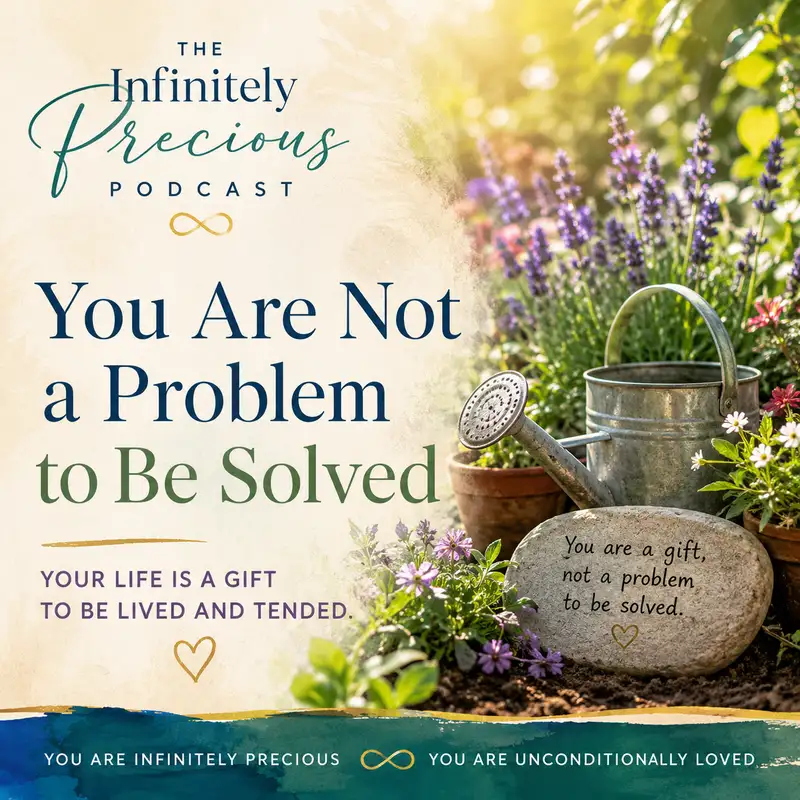
You Are Not a Problem to Be Solved
Welcome to the Infinitely Precious Podcast produced by Infinitely Precious LLC. Your host is James Henry. Remember, you are infinitely precious and unconditionally loved for the gift you already are.
James:Hello, beloved. It's me, James, with another opportunity for us to be companions on this journey, the infinitely precious journey that each of us is on. I was thinking this week as I've been working to try to stay in nutritional ketosis about how we so often think of ourselves as problems needing to be solved. To clarify what I meant by that, two or three months ago, I started on a keto diet to try to lower my A1C, a measure of blood sugar, to try to, to take care of this body that's part of me, that I inhabit, that is my sensory organ to connect to this world in which I have been made manifest and real. And this past week I had the opportunity.
James:It was a wonderful opportunity. I got to first of all do a wedding and then go to some friend's house for dinner. And in both of those cases, I was a little bit out of control about what food I would be eating. And if you know anything about keto diets, it's very low carbs. Not no carbs, but low carbs.
James:And so there was a lot of uncertainty about whether I'd stay in ketosis. And it caused me to fret and be anxious about how I could solve this problem that is my body. I don't know about you but I suspect that this is a common problem for us all. We stop treating our lives as something to be lived, to be enjoyed, and instead as a problem to be solved. Maybe we have body image issues and we think we are too big or we are too small or we are not tall enough or we're not pretty enough.
James:And so we do all sorts of things to try to get ourselves into that imagined state, that place where people will see us the way we hoped they would see us. We obsess about whatever it is we might wear or how people will receive us in a world outside of ourselves. And I've talked about that a little bit before. But when we begin to treat ourselves as problems to be solved rather than people who are living a life meant to be experienced, enjoyed, challenged, engaged, all of those pieces, then we can lose track of the beauty of this world in which we live. The beauty of the life we have been given to live.
James:I know for me, it was a wake up call on Friday and Saturday as I measured my ketones, took my blood on first Friday afternoon and then Saturday afternoon concerned about what would be the situation in terms of ketosis? How many times do we step on the scale or look at our social media metrics or look into our inbox es and begin to measure ourselves by what we produce, determine our value by something outside of ourselves and try to solve that problem. Often a problem that we've created or we've allowed the world to tell us we have. Not a problem we had to begin with, but a problem we've created and then we become the problem And then we become the solvers of the problem that is us. And the whole Infinitely Precious podcast is predicated on the idea that you're already infinitely precious.
James:There's absolutely nothing you can do to get any additional accolades for your connection to god. There's nothing you can do to be any more precious than you already are. Transformation is a part of life. We grow, we learn, we discover, we ripen. I love that language.
James:We ripen in this life. But ripening happens as we attend to who we are, as we live this life that's given us, not attempting to solve the problem that we perceive it to be, but instead living it to the fullest extent. I can't tell you how many afternoons, Sunday afternoons in particular, where I have obsessed over some sentence I tripped over in the morning sermon when I was preaching. Something I said that maybe I wish I hadn't said quite the way I said it. And that kind of curating my self as a problem to be solved because sermons are an expression of who I am.
James:Yes, I may spend a lot of time working on them, outside sources and preparing, but in the end what I express is an expression of myself. And oftentimes the things that I find myself obsessing over are a turn of phrase I might have used, or something I left out. Always trying to fix the problem. And everything in life then becomes about optimization. How do I optimize my spirituality?
James:How do I optimize this body I've given? How do I optimize my attention? How do I optimize my emotions so that I'm the best person who can be available in any given moment? And then even I have apps on my watch that measure how well I slept last night. And then it's a competition to see, can I sleep any better?
James:All about optimizing things instead of living those very experiences instead. So what do we do? Well, first of all, we recognize that we are treating ourselves. I think that the most important thing, we recognize we are treating ourselves like we are problems to be solved. Whether it is trying to lose some weight, trying to change our diet, trying to optimize the work that we've done, be the most productive we can be, improve the way we appear.
James:All of those things that we try to optimize in our lives. We just need to recognize, oh I'm treated. This is a moment when I'm thinking of myself as a problem to be solved. And see I'd like to believe that this conversation we're having this shared thought that I'm giving you from in this podcast is something that I discovered in response to. I wish it immediately popped up when I was sitting, when I was checking my ketones on Friday and Saturday.
James:I wish it had meant, oh, I'm treating myself like a problem to be solved. No, I knew something was off, but I couldn't figure out or put to words. And these are the words that appeared to me when I was journaling on Monday morning this week: I am not a problem to be solved and neither are you. You are already infinitely precious for who you are. Why can't we just get that through our heads?
James:I'm not saying to you never grow, but I want to invite you to instead of thinking of yourself as some kind of machine that can be optimized and tweaked and fine tuned, imagine your life as a garden to be tended. You know, can't control exactly how much sun or how much rain happens. Sure, you can water and weed and do all sorts of things, find the best seeds to plant and still sometimes the garden doesn't grow the way you expected. It ripens in its own way. You can only tend it.
James:Think of your life like a beautiful garden to be tended. Not to be fixed, but to be tended. Recognizing that some things are just outside your control. And some things you can tend better than others just because of who you are and the way you tend them. And ultimately, that can make it beautiful.
James:You know, we think of gardens oftentimes when I plant a garden, particularly if it's a food garden, I think of it what it's going to produce. I skip over the part where isn't it beautiful to watch plants pop up and grow or not grow and how they all are, you know, very similar seeds and yet the plants turn into their sort of own expression. I skip over that because I'm looking for that cucumber or tomato. Not looking for tomatoes anymore because those are off the keto diet. But you know, I'm looking for that thing that's going to be produced rather than the joy of tending the garden.
James:Think of your life as a beautiful garden to be tended. And there are seeds waiting to come up. Maybe they're lying dormant now. There are seeds that have already popped up and maybe they're growing in unruly ways that feel chaotic to you and out of control. And yet, is there a way that you can look at that garden that is your life and think of it as a gift?
James:Is there a way I can look at this unruly garden that is my life to tend and see it for the gift that it is? Because as quickly as we might use words like perfection, completion, all those kinds of things, perhaps what we're hoping for really is that we'll keep ripening and that in the end, we will find wholeness, completeness, peace, the Aramaic word, shlama, Hebrew word shalom. Those words meant not just a kind of peace but a wholeness, a completeness. You are whole. Invite all of the disparate parts of yourself to be guests in your garden at your banquet as present in precious and beautiful ways.
James:And remember, you're not a problem to be solved. Your life is not a problem to be solved. It is a gift meant to be lived and experienced. And if you can sink into each experience, attend to the moment, Sometimes you are going to fail. This is another opportunity to beat yourself up.
James:I missed this moment to attend. Instead, we learn moment by moment, sometimes by attending and sometimes by missing our attention. We learn to more deeply embody the moments we find ourselves in. That is what I wish for you. You will recognize that you truly are infinitely precious and unconditionally loved.
James:That the love will never be taken you. It's unconditional. It's a gift because you are a gift. You are a gift, not a problem to be solved, just the gift of who you are. Bring that giftedness to every moment of your life.
James:Be who you are and know that that in and of itself is a gift to us. Thanks for being on this journey with me. If this has been helpful to you, I encourage you to share it with someone else. But nonetheless, no matter what, remember you are infinitely precious and unconditionally loved for the gift you already are. Thanks for joining me today.