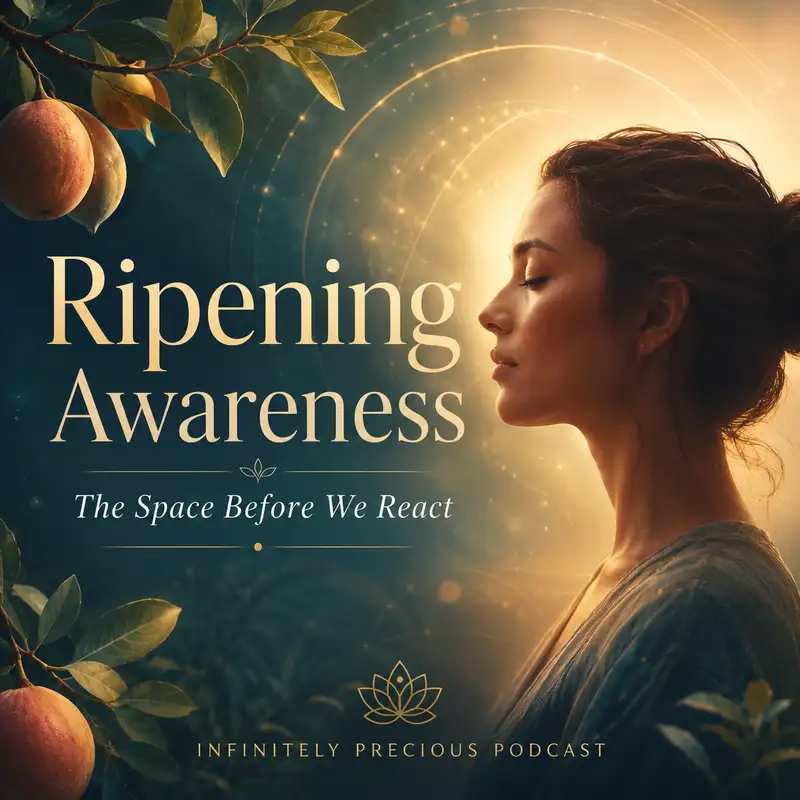
Ripening Awareness: The Space Before We React
Welcome to the Infinitely Precious podcast produced by Infinitely Precious LLC. Your host is James Henry. Remember, you are infinitely precious and unconditionally loved for the gift you already are.
James:Hello, beloved. It's me, James, and welcome to another episode of the Infinitely Precious podcast. It's a delight to be your companion and to have you be mine on this journey of living that we're a part of. If you've been following along, we have been doing a nine week series with one interruption. And we're on week seven.
James:We're talking about ripening and different dimensions of our lives that can ripen. Now, I've already used this disclaimer before, but I'll say it just in case this is the first time you're listening. I don't believe the nine ripening dimensions about which I speak and the practices associated with them are exhaustive. Started with eight And after sitting with them for a while, I realized something was missing. So I added a ninth.
James:There's nothing to say that the future won't have me deciding that one of them is not a dimension that is as important to me anymore. Go back to eight. Could discover another, could be 10. So for me, these are just ways of engaging this reality in which we find ourselves, this beautiful, huge, infinite universe of which we're a part and of being awake to that experience. And speaking of being awake, the seventh practice is ripening awareness.
James:Now, I chose the term ripening on purpose. Ripening because there are moments when we're moving closer to more full realization of these dimensions and there are moments when we are not. And sometimes that ripening just happens. It's not because we did anything particular. It is something that happened because we are in a particular space in a particular moment, and our heart opens, our mind opens, our perception opens, something along those lines.
James:And ripening awareness is a stance, perhaps is encouraged by a stance of openness, of being present in the moment. Talked a little bit about this before, present in the moment. One of the ways I try to cultivate awareness is by my practice of Centering Prayer, which is really a form of meditation where we sit twenty minutes. And during that twenty minute period of time, as the thought arises, we release that thought. We choose a sacred word, usually a one syllable, and we use that word to release anything that arises, to bring us back to our intention, to release those thoughts, feelings, emotions, distractions that arise in the moment.
James:Ripening awareness is just the practice of that in our everyday lives. As we become more present in the moment, we also become aware, maybe not a long time, maybe like a nanosecond before, that there are things rising in us, reactions to what's happening in the moment. Somebody says something and it sparks something, perhaps a negative something inside of you. At least you would perceive it as negative. It sparks something in you and you want to say something in return.
James:You want to do something in return. You want to walk away or stomp away or whatever it may be. You begin to, in a ripening awareness, recognize what's coming up. You recognize and you see it. And in that split second, you choose whether or not to let that reaction be your choice.
James:So for the longest time in my life and even today, reactions are things I didn't choose. They rise up in me and I just do them. Somebody makes me angry and I say the first thing that comes to my mind, the first thing that leaps out. And often that's a defensive thing that's designed to hurt the other, to push the other back, to show my dominance, my alpha male qualities, whatever it may be, I react. And it is quick and immediate.
James:And for the longest time, I believe that when I think of ripening awareness, it is a desire to not do the instinctual thing. As human beings evolved, I'm convinced through a variety of readings I've done that as we evolved, we evolved to protect ourselves. And when something is bearing down on you, a predator or something else, you don't have time to think about it. You need to react for your own safety. And the amygdala, a piece of our brain, controls that.
James:It shuts down all the thinking and just turns on the reaction. And sometimes we need the amygdala to engage when we have to suddenly pull ourselves back from being in front of a car or we're running and then we notice something that if we keep running, we'll run into. Something along those lines stops us immediately. We need that. But oftentimes the reactions we feel, we feel like are self protective.
James:They're about survival, But they aren't. My reacting to somebody saying something that pushes my button, that flares a little anger or self protection, because that's what anger really is. It's the rising of pain. It's the fear. And the fear turns into anger because we want to protect ourselves.
James:It's as that is rising, we get to choose. And in my best moments, my most ripe awareness moments, I see what's rising up. And I choose not to let that be what I do in that moment. Sometimes I just let it pass over me or pass through me or pass out of me without doing anything about it at all. And maybe nobody with whom I'm talking or sitting has any idea that what was rising in me was a quick witted and ugly response.
James:Or they may see something pass over my face, but it passes quickly because the reaction does not come to fruition. It rises up desiring center stage and I let it go. Now, are lots of things you can do to cultivate this ripening awareness. It's a dimension of being alive. But part of it is learning to recognize the signals our bodies give, our minds give, the things we feel, and recognizing that not everything that rises in us needs to emerge.
James:So one of the practices I've already mentioned it is meditation in one form or another. For me, that's centering prayer, but for you, it might be something else altogether. And you just come to recognize when your mind is just looking for something to do and that you want to react in a given moment. One of it is to practice breathing. And you can begin to practice breathing between speaking back to another person.
James:So much of our listening, so much of us, the way we engage in our culture anyway, is not so much listening as it is listening to respond. We listen so that we can say something back. Well, ripening awareness, ripe awareness would recognize that I don't need to respond immediately. I can catch my breath. And in that moment of catching my breath, however long that is, I can decide if the thing I wanted to say in response that was rising in me is something I need to say or something I can let go.
James:Once again, the reaction does not become automatic. It becomes something I can watch rising. And then I find myself as my awareness is ripening, more aware of all my surroundings, more aware of being present with the other, more aware of a deeper spaciousness that allows the other person to speak into my life. And it's a beautiful opportunity that I might have missed if my initial reaction came to fruition. That thing that rose in me, I let it out my mouth.
James:We don't have to do that. We don't have to immediately react. There are situations probably good. We talked about traffic. We talked about other kinds of situations in which we're in danger.
James:But for the most part in a conversation with someone else, the need to react is self perceived. The desire to react may be there, but needing to react is my own perception. So I can let that rise and let that go. So this was the seventh in our series about the ripening dimensions of being alive. I encourage you to try to practice ripening awareness if you find it helpful.
James:Certainly always welcome your responses to the Infinitely Precious podcast. You can email me at jamesinfinitelyprecious dot org. I'd be delighted to respond. If there's a topic you wish I would address, I'm delighted to at least entertain it. There are some things I'm not sure I would feel qualified or feel something appropriate to responding, and I'll tell you that.
James:So thankful that you joined me. I hope you'll share this. If it's been meaningful to you, share your thoughts with me. Until the next time, please remember what is most important, which is you are already infinitely precious and unconditionally loved for the gift you already are. You already are.
James:Precious, loved, and a gift. And that is a wonderful place from which to live your life. Thanks for joining me. I see will you, be with you the next time.